Uganda
In Uganda, more than 95 percent of the country has stable malaria transmission, with malaria infections occurring all year round. Although malaria affects both men and women of all ages, gender and youth dynamics play a key role in determining health outcomes for individuals. Maternal, newborn and child health indicators are poor, unevenly distributed across the country and worse in specific vulnerable populations – 28 percent of maternal deaths occur in young women aged 15 to 24 years – and there here remains a shortage in healthcare workers. We work with the Ministry of Health and project partners to improve integrated community case management and strengthen disease surveillance, identifying gaps in coverage through the lens of gender and youth.
Malaria Consortium in Uganda
In Uganda, we have led in the distribution of long-lasting insecticidal nets (LLINs)– through mass distribution campaigns as well as continuous distribution at health facilities. Through our work on integrated community case management (iCCM) and social and behaviour change (SBC), we provide evidence to scale up innovative approaches to target malaria and other childhood diseases. Our implementation research supports the strengthening of surveillance systems and monitoring and evaluation efforts to ensure the timely use of quality data.
In support of Uganda’s National Malaria Control Strategy, USAID’s five-year Malaria Action Program for Districts (MAPD), which ran from 2016-2021, Malaria Consortium sought to reduce maternal and childhood morbidity and mortality due to malaria.
Together with Banyan Global, we conducted a qualitative study to identify how gender- and youth-related norms might be hindering effective malaria control in Uganda.
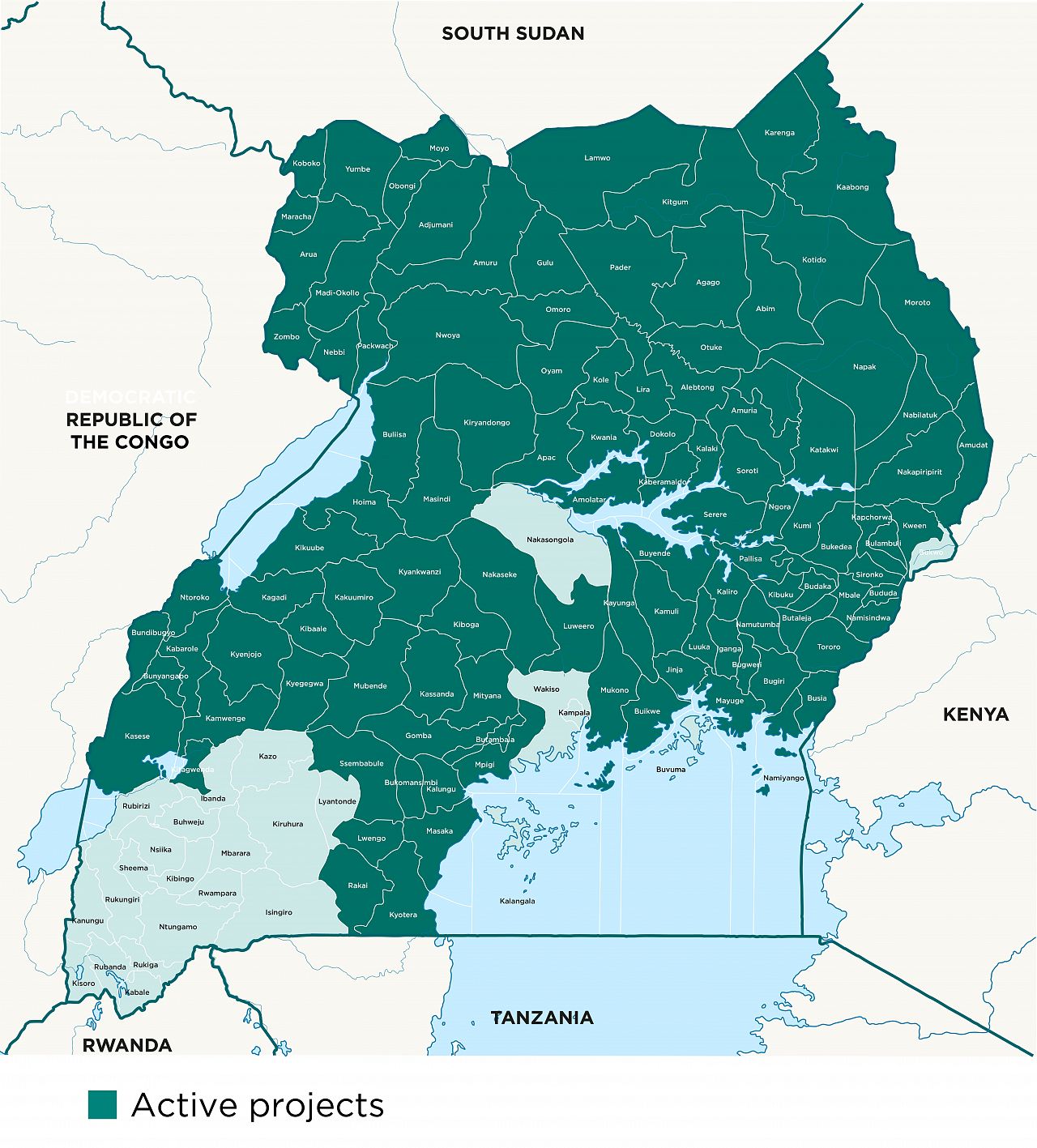
Areas of focus
Related content
 Resource: Presentation
Published 26 April 2024
A cluster randomised controlled trial to compare sulfadoxine-pyrimethamine and amodiaquine with dihydroartemisinin-piperaquine for seasonal malaria chemoprevention in Karamoja region, Uganda
 Resource: Presentation
Published 26 April 2024
Harnessing the power of routine data for decision-making and programme improvement: Lessons from delivering seasonal malaria chemoprevention
 Resource: Project report
Published 25 April 2024
Malaria Consortium’s seasonal malaria chemoprevention programme: Philanthropy report 2023
 Resource: Project report
Published 25 April 2024
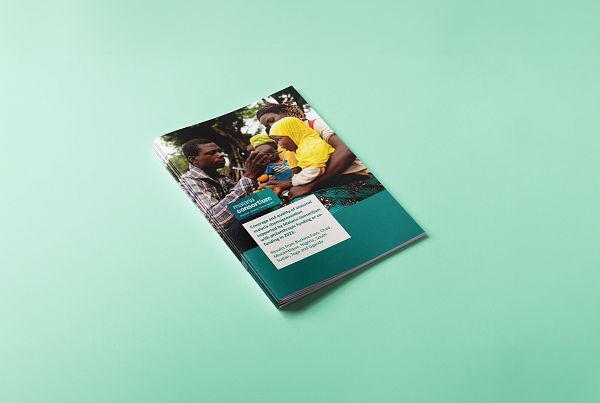
Coverage and quality of seasonal malaria chemoprevention supported by Malaria Consortium in 2023
 Resource: Presentation
Published 25 April 2024
Evaluating the impact of seasonal malaria chemoprevention on markers associated with drug resistance in Karamoja region, Uganda
 Resource: Presentation
Published 25 April 2024
Evaluation of seasonal malaria chemoprevention implementation in predominantly nomadic pastoralist communities in Karamoja region, Uganda
 Resource: Poster
Published 24 April 2024
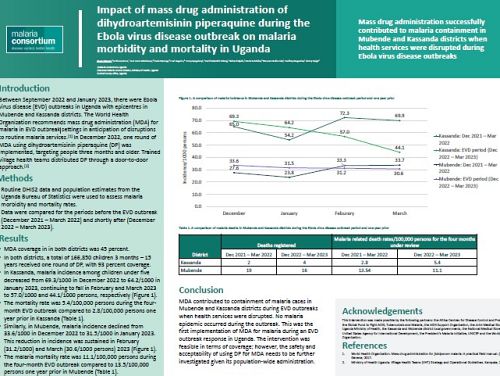
Impact of mass drug administration of dihydroartemisinin piperaquine during the Ebola virus disease outbreak on malaria morbidity and mortality in Uganda
 News:
News:Published 23 April 2024
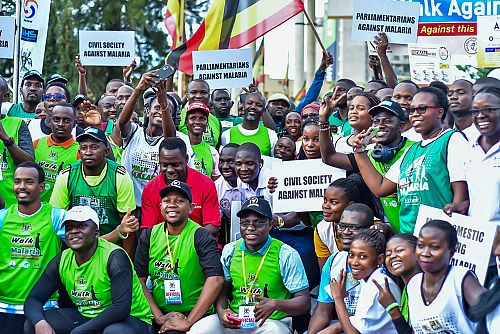
Malaria Consortium honoured by Ugandan government for contribution to combat malaria
 Resource: Poster
Published 23 April 2024
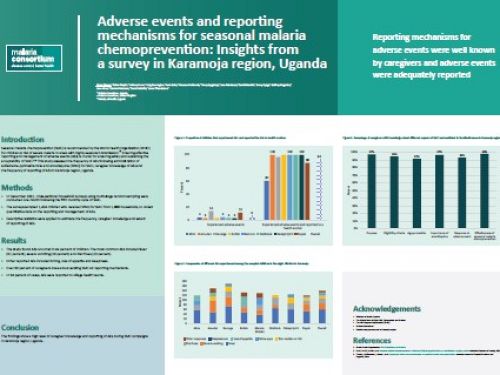
Adverse events and reporting mechanisms for seasonal malaria chemoprevention: Insights from a survey in Karamoja region, Uganda
 Resource: Project brief
Published 23 April 2024
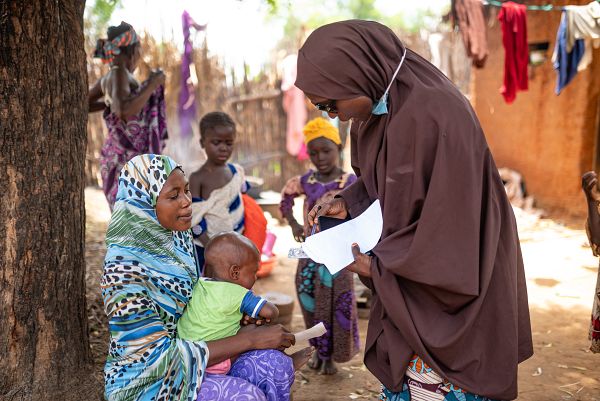
Seasonal malaria chemoprevention
 Resource: Poster
Published 22 April 2024
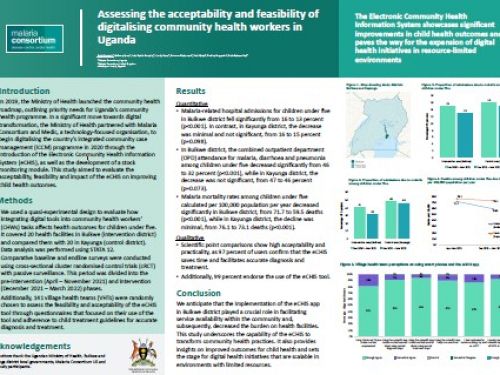
Assessing the acceptability and feasibility of digitalising community health workers in Uganda
 Resource: Poster
Published 22 April 2024
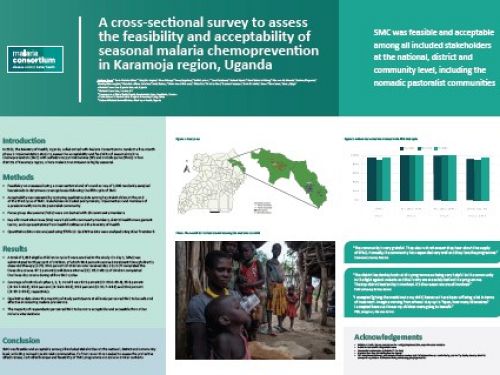
A cross-sectional survey to assess the feasibility and acceptability of seasonal malaria chemoprevention in Karamoja region, Uganda
 Resource: Project brief
Published 28 March 2024
Strengthening Uganda’s preparedness against arboviral threats
 Page:
Page:About us
 Blog:
Blog:Published 7 March 2024
International Women's Day 2024: Seven ways to make health programmes gender intentional
 Page:
Page:International Women's Day 2024: Seven ways to make health programmes gender intentional
 Page:
Page:Our third year as an Independent Research Organisation: Using research to respond to health inequities and emerging threats
 Blog:
Blog:Published 20 February 2024
Our third year as an Independent Research Organisation: Using research to respond to health inequities and emerging threats
 Page:
Page:International Day of Women and Girls in Science 2024
 Resource: Annual review
Published 2 January 2024
Trustee's report and financial statements for the year to 31 March 2023 Project:
Published 1 January 2024
Forecasting Outbreak Risks from Extreme Climate with Active Surveillance Technology Project:
Published 1 January 2024
Strengthening Uganda’s preparedness against arboviral threats (SUPAAT)
 Page:
Page:The impact of Global Fund investment in fighting malaria
 Page:
Page:Top reads of 2023
 Blog:
Blog:Published 15 December 2023
Top reads of 2023
 Blog:
Blog:Published 12 December 2023
A universal approach to health: Q&A with Dr George Upenytho, Uganda's Commissioner of Community Health
 Resource: Presentation
Published 6 December 2023
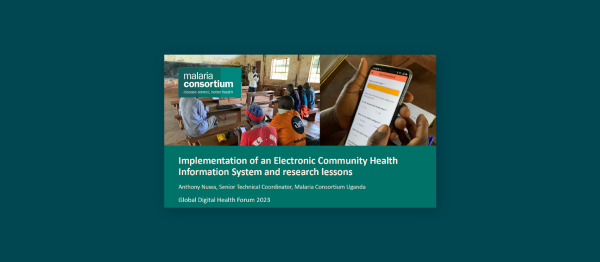
Implementation of an Electronic Community Health Information System and research lessons
 Resource: Poster
Published 5 December 2023
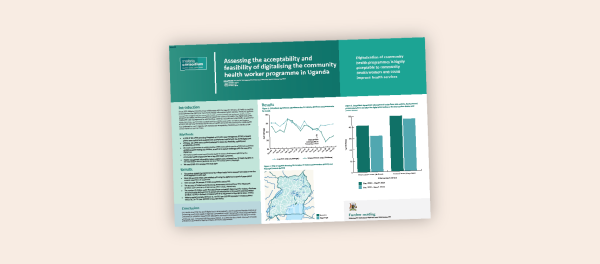
Assessing the acceptability and feasibility of digitalising the community health worker programme in Uganda