
The SEND Malaria project aimed to accelerate the safe and equitable introduction of the malaria vaccine in Uganda by providing embedded technical leadership to the Ministry of Health and generating strong, sustained community demand for the vaccine across Karamoja’s nine districts.
Objectives
- Provide dedicated technical support to Uganda's Ministry of Health by embedding a vaccine technical advisor within UNEPI and NMED to coordinate and guide the national malaria vaccine introduction across 105 districts.
- Increase awareness and demand for the malaria vaccine in Karamoja through a culturally tailored SBCC strategy targeting parents, caregivers, community leaders and religious groups, reaching over one million people through mass media.
- Strengthen health system capacity by training health workers, community health volunteers and district health teams to integrate malaria vaccination with existing prevention efforts, and to support data quality at facility and district level.
- Ensure equitable vaccine access and delivery by addressing logistical barriers, synchronising community mobilisation with service delivery outreaches, and reaching nomadic and hard-to-reach populations across all 154 health facilities in Karamoja.
Outcomes and impact
- The SEND-Malaria Vaccine project is expected to reduce malaria-related morbidity and mortality significantly among children under five in Karamoja, contributing to Uganda’s national malaria elimination goals.
- Enhanced vaccine demand. The initiative will raise awareness and acceptance of the malaria vaccine among communities, leading to higher uptake and better protection for children. It will also reinforce integrated malaria prevention behaviours, such as continued use of mosquito nets, indoor residual spraying and prompt treatment of malaria cases.
- Strengthened health system capacity to ensure equitable access. Building the technical capacity of health workers in vaccine administration, communication and outreach strategies will ensure efficient and effective service delivery in hard-to-reach areas.
- Integrated approach to malaria prevention. Data generated from this project will support evidence-based decision-making by national and regional health officials on the integration of malaria vaccination into Uganda’s routine immunisation programme and broader malaria prevention strategies. Insights will inform future malaria vaccine rollouts in similar settings, particularly regarding overcoming vaccine hesitancy, ensuring equitable access and optimising service delivery to nomadic populations and communities lacking access to healthcare.
Background
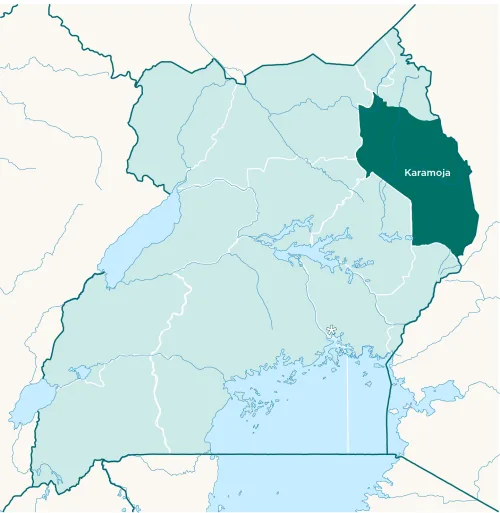
Malaria is the leading cause of illness and death among young children in Uganda, accounting for over 30 percent of outpatient visits and 20 percent of hospital deaths.[1] The burden is particularly severe in the Karamoja subregion, northeastern Uganda, with some of the highest malaria prevalence rates in the country: 34 percent in under-fives compared with the national average of nine percent.[2] The situation is exacerbated by limited healthcare infrastructure, seasonal malaria peaks, nomadic lifestyles and limited resources. Despite existing interventions such as long-lasting insecticidal nets, indoor residual spraying and seasonal malaria chemoprevention (SMC), malaria remains a persistent threat.
Uganda’s Ministry of Health, in partnership with the World Health Organization (WHO), Gavi, the Vaccine Alliance and UNICEF, is introducing the malaria vaccine into the national immunisation programme to reduce severe malaria cases and child mortality.[3] Given Karamoja’s unique epidemiological and sociocultural context, a strong demand generation and community engagement strategy is essential to ensure vaccine acceptance and uptake. The SEND — Malaria Vaccine project leverages existing health systems to build vaccine confidence and promote a multipronged malaria prevention approach.
Key activities
Uganda’s Ministry of Health is leading overall coordination; Malaria Consortium is spearheading the rollout of SMC, leading community engagement and SBCC activities, supporting village health team (VHT) training and supervision, and documenting lessons from the integration. WHO, UNICEF and Gavi are primarily supporting malaria vaccine delivery, supply chain and immunisation system strengthening, with Malaria Consortium ensuring alignment at the community level and contributing to joint planning, monitoring and learning.
Malaria Consortium is implementing an SBCC strategy to address misconceptions, vaccine hesitancy and cultural concerns through community influencers, radio broadcasts and mobile van campaigns. VHTs are running interactive community sensitisation sessions and visit households.
Health workers and volunteers trained to administer vaccines and address caregivers’ concerns are visiting nomadic populations and communities lacking access to basic health services. Outreach vaccination is being integrated with SMC campaigns to maximise coverage. Malaria Consortium is establishing a monitoring and feedback system to track vaccine coverage, address challenges and adapt strategies based on real-time data.
References
- Uganda Ministry of Health. Uganda Malaria Indicator Survey 2022–2023. Kampala: Ministry of Health; 2023.
- World Health Organization (WHO). World Malaria Report 2023. Geneva: WHO; 2023.
- Uganda Bureau of Statistics (UBOS), ICF. Uganda Demographic and Health Survey 2022. Kampala, Uganda, and Rockville, Maryland, USA: UBOS and ICF; 2023.
Related content

One visit, many lives saved: How to fight malaria smarter

Uganda launches a landmark malaria vaccine rollout, with support from Malaria Consortium

Taking a supermarket approach to healthcare integration in remote districts: Experiences from Uganda

SEND — Malaria Vaccine: Strategic engagement from national level to community delivery
Strategic engagement from national level to community delivery — malaria vaccine integration phase 2 (SEND 2)
Malaria Consortium is supporting the introduction and rollout of the malaria vaccine as part of Uganda’s Essential Programme on Immunisation (EPI), focusing on strengthening demand generation, community engagement and health system preparedness to ensure high vaccine uptake and acceptance. Malaria Consortium is collaborating with Uganda’s National Malaria Control and Elimination Division and the EPI — alongside WHO, Gavi and UNICEF — to deliver an integrated malaria prevention approach.
Start date
01/07/2024
End date
31/07/2025
Country/
Countries
Countries
Africa >
Uganda
, Burkina Faso
Funder
Malaria Consortium US
Partners
Gavi, the Vaccine Alliance; Karamoja District Health Management Team; Ministry of Health Uganda, National Malaria Elimination Division (NMED); Uganda Essential Programme on Immunisation; UNICEF; World Health Organization