
Safety and antimicrobial resistance of mass administration of azithromycin in children in Nigeria (SARMAAN II)
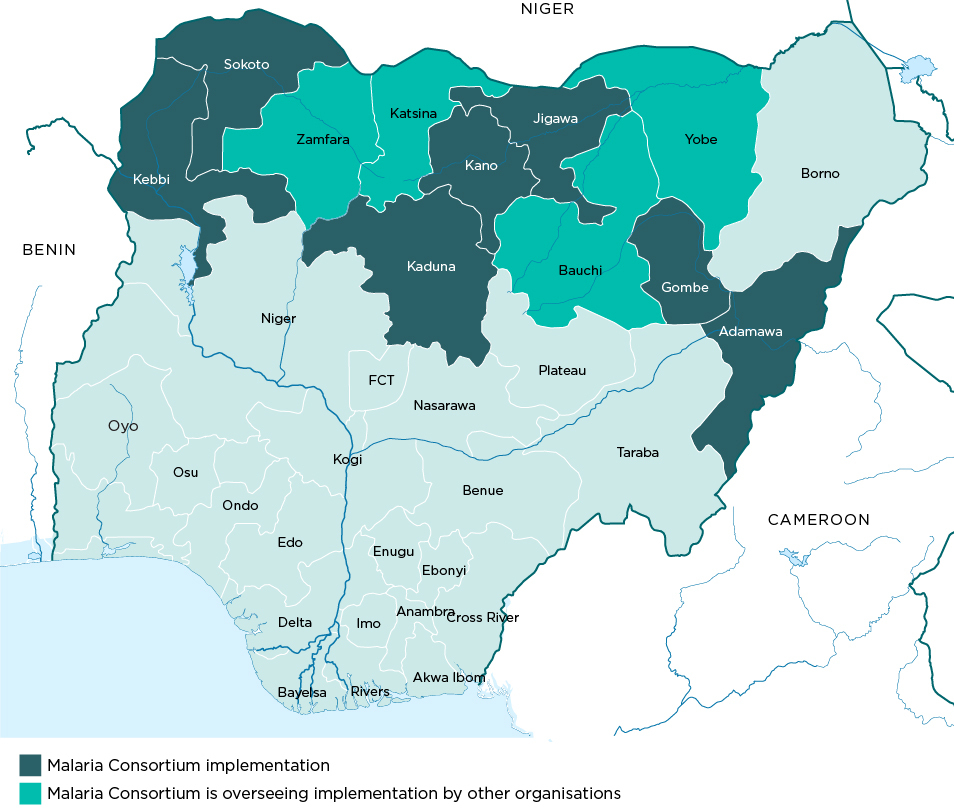
Malaria Consortium is supporting the scaling up of mass drug administration of azithromycin (MDA-AZM) to children aged 1–59 months across 11 states of Nigeria, to reduce cases and deaths from malaria, pneumonia and diarrhoea.
Objectives
- Evaluate the coverage, equity and impact of MDA-AZM on child health outcomes.
- Explore and understand the implementation processes, challenges and successes of MDA-AZM co-administration.
- Co-design context-specific implementation strategies and deliver MDA-AZM through integration with polio, NTD and SMC campaigns.
- Increase MDA-AZM coverage in five northern states reaching approximately nine million children aged 1–59 months old each year.
Outcomes and impact
Optimal reach through tailored delivery to ensure the greatest impact on child survival in northern Nigeria. Context-specific implementation through integration with established platforms in each state ensures community engagement and effective delivery.
Improved efficiency of campaign delivery, while maintaining quality and effectiveness of interventions. Full or partial integration of child health programmes could harness potential synergies through shared approaches to planning, training, supervision and logistics. A deeper understanding of the health systems across our locations helps to identify other potential areas for integration.
Deeper understanding of the benefits and risks of mass drug administration of azithromycin. By exploring the impact of extending MDA-AZ to all children under five on antimicrobial resistance and adverse drug reactions, SARMAAN II will help to inform national and international policy and practice.
Background
Nigeria has made significant strides in reducing child mortality, from 126 to 105 deaths per 1,000 live births (a 17 percent decrease) between 2015 and 2023.[1] However, preventable childhood illnesses, including malaria, pneumonia and diarrhoea, still pose a considerable threat to child health. Nigeria accounted for 24 percent of malaria cases and 30 percent of malaria deaths globally in 2024.[2] Mass drug administration of the antibiotic medicine azithromycin (MDA-AZM) has the potential to decrease the incidence of all three illnesses and set Nigeria back on track to meet targets. The World Health Organization (WHO) recommends MDA-AZM for children aged 1–11 months in areas of sub-Saharan Africa with high infant mortality rates.[3] Implementation requires continuous monitoring for adverse effects and resistance, and strengthening of other child survival interventions.[3]
The Nigeria Institute for Medical Research (NIMR), in partnership with Malaria Consortium and other partners, conducted the Safety and Antimicrobial Resistance of Mass Administration of Azithromycin in Children (SARMAAN I) study between 2021 and 2023 to evaluate the risks and benefits of MDA-AZM in children aged 1–11 months. SARMAAN I provided evidence on the operational feasibility, acceptability and practicality of delivering azithromycin through different platforms.
Project outline
Following data from Niger which suggested that MDA-AZM has optimal impact when given to all children under five,[4] SARMAAN II takes an ‘implementation +’ approach, targeting children aged 1–59 months across eleven states. Scale-up across four states commenced in 2024, with lessons learnt informing subsequent scale-up in an additional seven states in 2025.
Malaria Consortium is supporting implementation in Adamawa, Gombe, Jigawa, Kaduna and Kebbi, using a dual platform approach to administer twice-yearly doses of AZM. The first dose uses the structure of the seasonal malaria chemoprevention (SMC) programme, while being administered separately from SMC. The second dose is being delivered six months later using existing neglected tropical disease (NTD) structures. Simultaneously, Malaria Consortium is overseeing partner organisations AFENET in Katsina, Yobe and Zamfara and MITOSATH in Bauchi state, who are leveraging the polio eradication programme and NTD MDA structures, respectively, to deliver AZM.
Activities
Malaria Consortium is implementing SARMAAN II with the Resiliency through Azithromycin for Children (REACH) network.
Pre-implementation phase: Government ownership and stakeholder support at all levels are being strengthened through advocacy and community engagement. Malaria Consortium and partners are establishing robust governance and operational structures, and developing training guidelines and materials. The Federal Ministry of Health and SOLINA are coordinating overall supply chain management, with implementation partners using existing systems for last-mile distribution.
Implementation phase: Project partners are developing an integrated campaign strategy to determine timing and implementation, with strategies to reach communities in conflict-affected settings. Use of existing monitoring and supervision frameworks for SMC, NTDs and routine immunisation ensures consistency across implementing states; collected data will be analysed to inform state action plans.
Post-implementation phase: Independent monitoring and end-process surveys will assess the reach and quality of implementation across the delivery platforms. Evidence
generated will contribute to discussions on MDA-AZM prioritisation nationally and globally.
References
1. UNICEF. Country profile: Nigeria. Accessed 16 October 2025.
2. WHO. World malaria report 2025. WHO; 2025.
3. WHO. WHO Guideline on mass drug administration of azithromycin to children under five years of age to promote child survival. WHO; 2020.
4. O’Brien KS, Arzika AM, Amza A, Maliki R, Aichatou B, Bello IM, et al; AVENIR study group. Azithromycin to reduce mortality — An adaptive cluster-randomized trial. New England Journal of Medicine, 2024; 391(8): 699–709.
Countries

