

Toronto, Canada will host the 74th American Society of Tropical Medicine and Hygiene’s (ASTMH) Annual Meeting this year, between 9 and 13 November.
As one of the world’s largest gatherings of public health experts, this annual event serves as an important platform to exchange cutting-edge knowledge across sectors and disciplines, laying the groundwork for real-world, life-saving impact.
In a rapidly changing global landscape, we’re committed to helping communities not just survive, but thrive. At this year’s ASTMH, we’ll highlight our work strengthening health systems, scaling locally led solutions and collaborating with local partners to carry out innovative research — generating evidence that can guide policy adoption and intervention uptake.
Our symposia, oral presentations and posters explore how research-driven data, innovative approaches like behavioural science, and implementation studies are supporting the optimisation of tools and interventions, tackling emerging threats like drug and insecticide resistance, and extending protection to hard-to-reach and mobile populations.
We will showcase several community-driven initiatives — from engaging caregivers and local leaders in malaria chemoprevention efforts in Nigeria to addressing antimicrobial resistance in rural Bangladesh. We’ll also highlight our ongoing efforts to advance malaria elimination, such as through insecticide-treated net distribution, and assess broader health challenges, from arbovirus preparedness to the long-term impacts of COVID-19.
View the full schedule of Malaria Consortium’s presentations below.
Not attending? Our posters and presentations will be available on our website on the day they’re presented. Join the conversation on X using #TropMed25.
-
Malaria vaccines in a new era of malaria control and elimination: latest insights from research and real-world implementation
This symposium, hosted by Malaria Consortium in collaboration with GSK, explores the transformative role vaccines could play in malaria control and elimination. With two World Health Organization (WHO)-recommended vaccines now being rolled out across Africa, experts will share fresh insights from research and early real-world implementation.
The panel will present updates on vaccine immunogenicity, efficacy and safety, alongside experiences from countries integrating vaccines into routine immunisation programmes.
Discussions will highlight key lessons on delivery, equity and next-generation vaccine development. By bridging research and field experience, the session will inform policymakers, scientists and programme implementers on how malaria vaccines could accelerate progress toward a malaria-free future.
The symposium will be co-chaired by Malaria Consortium’s Chief Executive, Dr James Tibenderana, and Dr Mary Hamel, former Team Lead, Malaria Vaccines, WHO.
They will be joined by Dr Rafiq Okine, WHO; Prof. Charles Wiysonge, Former Lead, Vaccine Preventable Diseases Programme, WHO AFRO; Dr Martina Oneko, KEMRI, Centre for Global Health Research; Dr Nnenna Ogbulafor, National Malaria Elimination Programme; and Dr Katie Ewer, GSK.
-
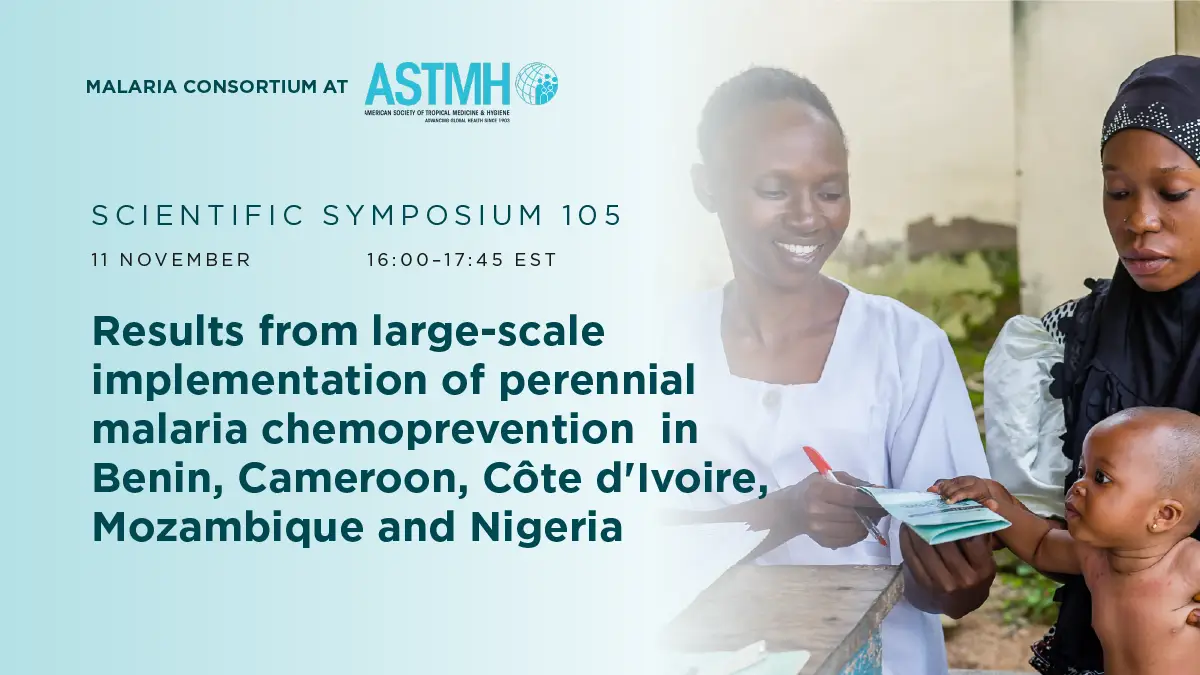
Results from large-scale implementation of perennial malaria chemoprevention in Benin, Cameroon, Côte d'Ivoire, Mozambique and Nigeria
New WHO guidance issued in 2023 recommended perennial malaria chemoprevention (PMC) as an intervention to prevent malaria in young children, encouraging countries to give more than three courses and increase the target age beyond children 12 months of age.
Drawing on evidence from the Unitaid-funded Plus Project and the Gates Foundation-funded PMC Effect project, speakers will share data on the operational feasibility, effectiveness, coverage, cost and cost-effectiveness of PMC.
Findings from the large-scale implementation of PMC in different epidemiological settings across Benin, Cameroon, Côte d'Ivoire, Mozambique and Nigeria are promising, providing practical lessons for policymakers. Speakers will discuss the implications of expanding PMC to other areas in these countries, as well as to other African nations.
The symposium will be co-chaired Malaria Consortium’s Chief Executive, Dr James Tibenderana, and Dr Corine Ngufor, Associate Professor at the London School of Hygiene & Tropical Medicine.
They will be joined by Dr Olusola Oresanya and Dr Chinazo Ujuju, Malaria Consortium Nigeria; Prof. Wilfred Mbacham, Fobang Institute for Innovation in Science and Technology; Dr Nnenna Ogbulafor, National Coordinator National Malaria Elimination Programme Nigeria; and Dr Shari Krishnaratne and Lucy Paintain, London School of Hygiene & Tropical Medicine.




Full schedule
Monday 10 November
8:30 – 10:15
Scientific session 5
Monica Anna de Cola
Oral presentation
6012 Estimating impact of seasonal malaria chemoprevention in Burkina Faso: A mathematical modelling framework
10:45 – 12:30
Scientific session 18
Helen Hawkings
Oral presentation
6067 Engaging communities to address antimicrobial resistance from a one health perspective: Results from a cluster randomised controlled trial in rural Bangladesh
12:30 – 14:15
Poster session A
Yonas Teshome
Poster
6156 Navigating long-COVID in East Africa: Patient experiences, healthcare gaps and system readiness in Ethiopia and Uganda
Chukwuebuka Ezihe
Poster
6197 Trends in insecticide resistance among Anopheles gambiae s.l. mosquitoes in Ondo and Anambra states in southern Nigeria
Lieven Vernaeve
(Presented by Dr Po Ly)
Poster
6339 The path to zero: Cambodia’s village and mobile malaria workers have driven the country towards malaria elimination
Olusola Oresanya
Poster
6394 Avoiding missed opportunities for perennial malaria chemoprevention: A systematic review of factors influencing the uptake of three other maternal and child health interventions
Michael Ekholuentale
Poster
6395 Caregivers, community leaders and health workers’ perspectives on the effectiveness of perennial malaria chemoprevention in Osun state, Nigeria: A qualitative study in process evaluation
Ebenezer Ikechukwu
Poster
6401 Assessing cohort retention and associated factors among seasonal malaria chemoprevention-eligible children in four West and Central African countries in 2024
Chinazo Ujuju
Poster
6403 Utilising the COM-B behaviour change model to increase the uptake of perennial malaria chemoprevention and routine immunisation in Nigeria
Anthony Nuwa
Poster
6405 Impact of seasonal malaria chemoprevention on incidence of malaria among children under five years in six districts of Karamoja subregion, Uganda
Semiu Rahman
Poster
6414 Perceived barriers and enablers for sulfadoxine-pyrimethamine perennial malaria chemoprevention implementation in Osun state: A qualitative analysis of the process evaluation study
Olabisi Ogunmola
Poster
6419 Enhancing cohort tracking for seasonal malaria chemoprevention campaigns using unique identifiers in Nigeria
Jennifer Chukwumerije
Poster
6429 Impact of seasonal malaria chemoprevention: A plausibility evaluation of routine data from health facilities in three implementing states in Nigeria
Benoit Sawadogo
(Presented by Ebenezer Ikechukwu)
Poster
6444 Monitoring the impact of malaria vaccine rollout on awareness, perceptions and coverage of seasonal malaria chemoprevention: Insights from routine programmatic data in Burkina Faso
14:15 – 16:00
Scientific session 36
Jane Achan
Oral presentation
6576 Efficacy and safety of intermittent preventive treatment of malaria in school-age children using sulfadoxine-pyrimethamine plus amodiaquine, and dihydroartemisinin-piperaquine plus Ivermectin in rural Burkina Faso
Ani Steele
Oral presentation
6579 Building an evidence base to inform the optimisation of insecticide-treated net distribution in three African settings
Tuesday 11 November
10:15 – 12:00
Poe Poe Aung
(presented by Shobiechah Wulandhari)
Poster
6744 Are we ready for arbovirus threats? Self-assessment of national
preparedness in four African countries
Symposium 65
Malaria Consortium and GSK
Malaria vaccines in a new era of malaria control and elimination: Latest insights from research and real-world implementation
12:00 – 13:45
Poster session B
Jane Achan
Poster
6946 Dynamics of malaria-specific antibody immune responses in a setting implementing seasonal malaria chemoprevention in Uganda
Anthony Nuwa
Poster
6962 A cross-sectional survey to assess the effect of rapid scale-up of seasonal malaria chemoprevention on feasibility and acceptability among nomadic pastoralist populations in Karamoja subregion, Uganda
16:00 – 17:45
Symposium 105
Malaria Consortium and Plus Project
Results from large-scale implementation of perennial malaria chemoprevention in Benin, Cameroon, Côte d'Ivoire, Mozambique and Nigeria
Wednesday 12 November
12:45 – 14:30
Scientific session 132
Shobiechah Wulandhari
Oral presentation
7744 Malaria — Getting to zero and staying there: Successes and challenges in malaria elimination
15:00 – 16:45
Poster session C
Richard Kajubi
Poster with lightning talk
7470 Impact of seasonal malaria chemoprevention on antimalarial drug resistance and the emergence of non-falciparum species in Karamoja subregion, Uganda
Matteo Bottecchia
Poster
7560 Closing the access-use gap in insecticide treated nets through behavioural science: Results from a feasibility study in Nigeria and Uganda
Ruth Kigozi
Poster with lightning talk
7583 Drivers of quality of routine health facility data in Uganda
Adaeze Aidenagbon
Poster
7615 Comparative analysis of azithromycin coverage when integrated with seasonal malaria chemoprevention delivery in Nigeria: A case study of Kebbi state