
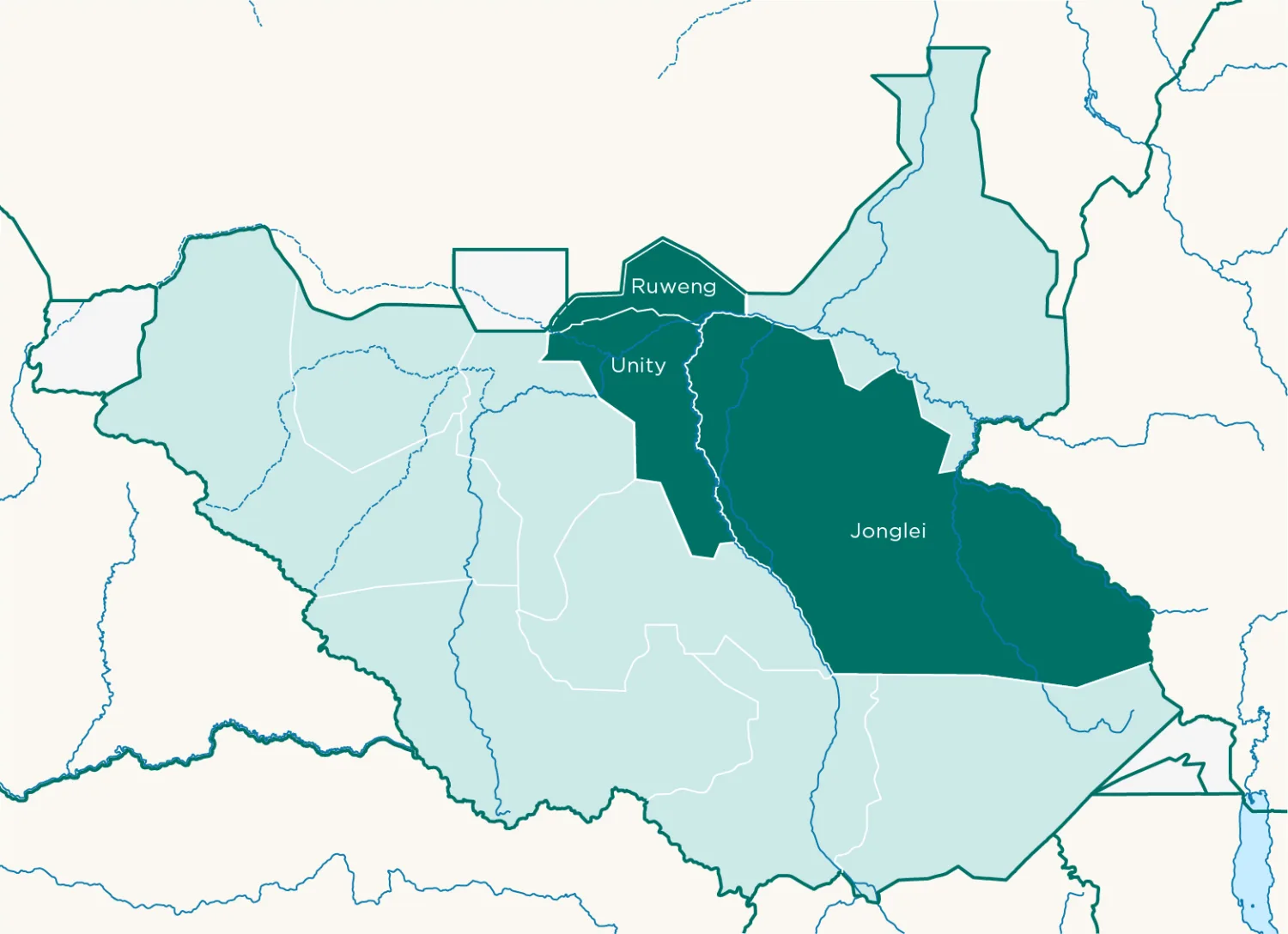
Malaria Consortium is implementing a long-lasting insecticidal net (LLIN) mass distribution campaign, incorporating community engagement to ensure that all households receiving nets make proper use of them. The campaign covers Unity and Jonglei states and Ruweng administrative area in northeastern South Sudan, where persistent flooding and increasing insecurity present heightened risks during delivery.
Distribution will be conducted through a single‑phase, door‑to‑door approach. In cases where insecurity prevents door‑to‑door distribution, a fixed‑point distribution approach may be used, with the requirement of prior approval from the Ministry of Health, UNICEF and Against Malaria Foundation (AMF).
Objectives
- Ensure delivery of LLINs to households is equitable and efficient.
- Ensure community awareness and active participation throughout the campaign.
- Guarantee safe and fully accountable movement of LLINs across all levels of the supply chain.
- Promote correct use and proper care of LLINs through robust social and behaviour change interventions.
Anticipated outcomes and impact
- Communities fully participate in improving health outcomes. By ensuring that all those who receive nets understand their value for malaria prevention, and know how to use and care for them correctly, we can close the gap between access to, and use of nets. This ensures sustained and equitable use.
- Reduction in malaria-related morbidity and mortality. Provision of quality LLINs to all communities within South Sudan will reduce malaria transmission and save lives. Strong working partnerships with government and implementation partners. Close collaboration with all levels of government is essential to the success of the campaign by driving engagement with project coordination, training and supervision.


Background
As part of strengthened malaria control interventions, the deployment of long‑lasting insecticidal nets (LLINs) in South Sudan aims to reduce malaria transmission, morbidity and mortality nationwide.
Malaria remains the leading public health challenge in South Sudan, with an estimated 8,315 cases and 18 deaths occurring every day, according to the World Health Organization (WHO).[1,2] Pregnant women and children under five are particularly vulnerable to malaria-related anaemia and adverse birth outcomes including low birth weight, severe illness and death. Recurrent flooding across many parts of the country in recent years has disrupted access to essential health services. This resulted in a sharp rise in malaria prevalence among children aged 6–59 months, from 32 percent in 2017 to 53 percent in 2023, according to the 2023 Malaria Indicator Survey. This situation has been further exacerbated by ongoing supply issues with antimalarial medicines.[3]
Although LLINs are one of the most effective preventive measures against malaria, use in South Sudan is low. Only 39 percent of the population sleeps under a net, despite distribution coverage reaching approximately 63 percent of the population.[3]
Activities
-
Planning
Malaria Consortium will undertake microplanning and logistics assessment, using detailed information on geographical locations to accurately estimate the number of LLINs required for distribution.
-
Distribution
The project team will work closely with the Ministry of Health to coordinate LLIN distribution. Registrars will distribute nets with the support of trained community communicators who will provide households with guidance on net care and use, with supervisors providing oversight of the distribution.
All registration and distribution activities will be fully digitised to enhance the efficiency of data collection and supervision of net distribution, enabling real-time access to coverage data. This builds on the successful digitalisation of the 2022 net distribution campaign in Northern Bahr el Ghazal, where digital tools significantly improved the efficiency of data collection.[4]
-
Training
In close collaboration with the Ministry of Health, Malaria Consortium will organise cascade training sessions at the state, county, payam (second lowest administrative division, with minimum population of 25,000) and boma (lowest administrative division) levels on the use of the digital tools for net distribution.
-
Monitoring
Joint monitoring will be conducted by the State Ministry of Health, County Health Department and Malaria Consortium. A third‑party organisation will carry out post‑distribution monitoring and household verification surveys.
-
Community engagement
Malaria Consortium will implement comprehensive community engagement strategies across all operational areas, using radio jingles and talk shows, as well as in-person awareness-raising to communicate the rationale and benefits of the intervention.
References
- WHO South Sudan. Malaria in South Sudan: Past, present and future. Knowledge Management Series for Health. December 2024.
- World Health Organization (WHO). Malaria 2025 South Sudan country profile. WHO; 2025.
- Ajak LKA, Butto D, Moses TDS. From distribution to utilization: Identifying implementation gaps and strategic entry points for long-lasting insecticidal net (LLIN) programmes in a
conflict-affected county of South Sudan. African Journal of Women in Leadership and Governance, 2025; 1. - Khan J, Mubiru D, Chestnutt EG, Cook L, Riiny LL, Okot F, et al. Usability of a digital tool to support long-lasting insecticide net distribution in Northern Bahr el Ghazal State, South
Sudan. Malaria Journal, 2024; 23: 318.
Malaria Consortium is implementing a long-lasting insecticidal net (LLIN) mass distribution campaign, incorporating community engagement to ensure that all households receiving nets make proper use of them. The campaign covers Unity and Jonglei states and Ruweng administrative area in northeastern South Sudan, where persistent flooding and increasing insecurity present heightened risks during delivery.
Start date
01/01/2026
End date
30/06/2026
Country/
Countries
Countries
Africa >
South Sudan
Funder
UNICEF
Partners
Against Malara Foundation (AMF), County Health Department, National Ministry of Health, State Ministry of Health, Relief and Rehabilitation Commission (RRC), UNICEF