

From funding pressure to sustaining impact: What we learned from the joint SMC Alliance and AMP annual meeting
by Celia Yeung
Approx reading time:
In February 2026, more than 300 delegates from over 30 countries gathered for the first joint annual meeting of the Seasonal Malaria Chemoprevention (SMC) Alliance and the Alliance for Malaria Prevention (AMP) in Kampala, Uganda. Organisations in attendance included the World Health Organization Global Malaria Programme, ministries of health, national malaria programmes, researchers, implementing partners and funders. The meeting focused on discussions on coordination and integration, data-driven decision-making, digitalisation, national ownership and funding realities — united by a shared goal of strengthening malaria prevention across Africa.
As a leading SMC implementer, Malaria Consortium was represented by colleagues from across our SMC-implementing countries and our global team, with the conversations grounded in operational reality. Across sessions, from integration and digitalisation to policy decisions and drug resistance, a common underlying question kept surfacing: how do we protect programme coverage, quality and equity when the environment around us is evolving constantly?
Below, our representatives reflect on what these discussions mean for sustaining SMC impact at scale and share five key takeaways from the meeting.
1) Integration must be strategic, evidence led and carefully managed
There is strong momentum towards integrating SMC with other malaria and child health interventions, including insecticide-treated nets (ITNs), vaccination, integrated community case management (iCCM) and broader community health services. These activities reflect a wider shift from vertical programmes to coordinated delivery systems, meaning these interventions are being integrated into shared national health infrastructure rather than run as a standalone, disease-specific programme. When done well, integration can improve efficiency, expand reach to underserved populations and strengthen overall health outcomes. However, integration is not a one-size-fits-all approach. It requires clear definition, careful assessment of trade-offs, consideration of delivery capacity, and context-specific approaches informed by operational evidence. Without this clarity, integration can mean different things to different implementers, leading to confusion, gaps in delivery or duplication of effort.
2) Funding constraints are reshaping programmes through cost optimisation, innovation and national ownership
A constrained and uncertain funding landscape is now shaping nearly all programme decisions, pushing countries to do more with fewer resources. This has driven a shift from simple cost reduction to cost optimisation, where efficiency must be balanced with maintaining coverage and quality, and where short-term savings do not undermine longer-term system performance. There is growing emphasis on exploring innovation in lower-cost delivery models, diversifying funding sources beyond traditional donors, strengthening domestic financing and political commitment and improving accountability. Greater focus is also being placed on clearer prioritisation of certain interventions to make the best use of limited resources, increased national ownership and the ability to demonstrate impact and value-for-money.
"As budgets tighten, the priority has to be cost optimisation rather than indiscriminate cost reduction. This means carefully balancing cost against public health impact to safeguard SMC coverage, quality and equity," says Christian Rassi, Programme Director of SMC at Malaria Consortium. "Integration offers real potential to strengthen delivery systems and cost-effectiveness, but only if it is evidence led, rigorously tested and designed around operational realities — not pursued primarily as a cost-saving exercise. Otherwise, there is a risk of undermining the very impact we are trying to sustain.
3) Digitalisation is becoming essential in translating data into decision-making
Digital tools are no longer optional — they are increasingly central to effective malaria programme delivery. Across countries, electronic systems are supporting microplanning, real-time monitoring and improved data quality. Used well, digital tools can connect campaigns, routine services and community-led delivery, strengthening coordination, targeting and operational efficiency. However, a key gap remains: ensuring data is used to drive timely decisions. Fragmented platforms, variable data quality and underuse of data contribute to limiting results. Greater platform integration, better quality and more accessible data, and stronger capacity to interpret and act on information will be critical to improving real-time decision-making at the operational level.
4) Drug resistance and changing epidemiology are reshaping SMC policy and practice
Growing concerns around antimalarial drug resistance, shifting transmission patterns (including climate change), and expansion of interventions to new geographies and age groups underscore the need for stronger, more coordinated evidence generation. Key priorities include strengthening resistance surveillance and linking evidence to policy and programme decisions, while ensuring SMC is targeted appropriately based on seasonality, age groups and epidemiological context. There is also a need to better align SMC with other chemoprevention strategies — such as perennial malaria chemoprevention (PMC), intermittent preventive treatment in school-aged children (IPTsc) and post-discharge malaria chemoprevention (PDMC) — and to adapt delivery models in response to evolving epidemiological and operational realities. Evidence must guide not only what is implemented, but where, how and for whom.
5) Community-level systems, political leadership and cross-sector engagement are critical to impact and sustainability
Sustained progress in malaria prevention depends not only on technical interventions, but also on high-level political commitment and community-level delivery systems. Community volunteers and community health workers remain central to delivery, and strengthening training, supervision and community engagement is essential to maintain SMC coverage and adherence among its recipients. Engagement beyond the Ministry of Health, including parliament, the Ministry of Finance and the private sector, could strengthen national ownership and unlock sustainable financing. Positioning malaria as a broader socio-economic and development priority, alongside stronger cross-border and cross-partner collaboration, will be key to maintaining momentum and achieving long-term impact.
As budgets tighten, the priority has to be cost optimisation rather than indiscriminate cost reduction. This means carefully balancing cost against public health impact to safeguard SMC coverage, quality and equity. Integration offers real potential to strengthen delivery systems and cost-effectiveness, but only if it is evidence led, rigorously tested and designed around operational realities — not pursued primarily as a cost-saving exercise. Otherwise, there is a risk of undermining the very impact we are trying to sustain.
Beyond SMC: The new Malaria Chemoprevention Alliance and its implications
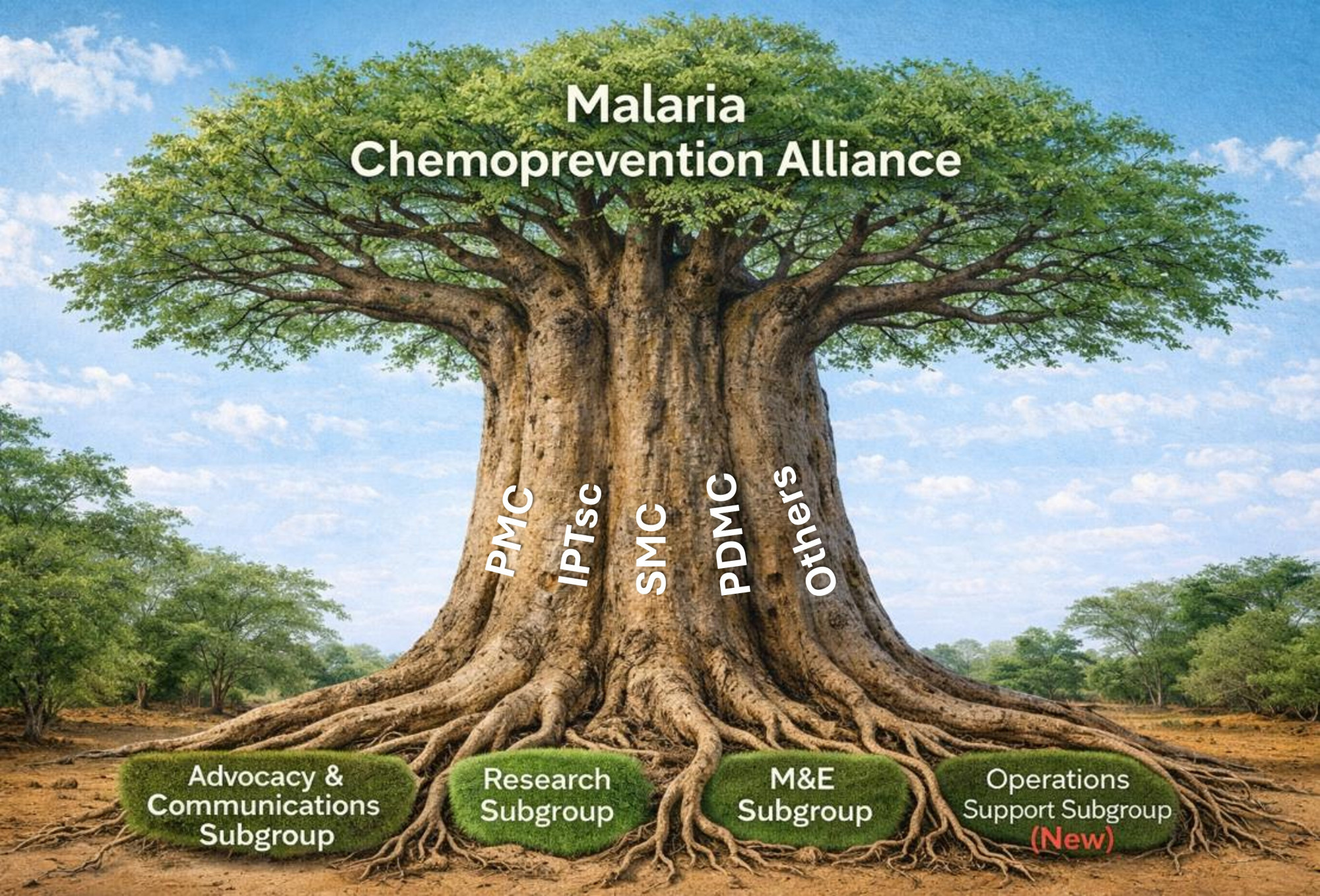
At the joint annual meeting, the SMC Alliance announced its transition to the Malaria Chemoprevention Alliance (the Alliance), signalling a strategic shift to address persistent equity gaps in malaria prevention across a child’s life course. Symbolised by the African baobab tree, the Alliance will act as an umbrella platform for communities of practice across chemoprevention interventions, including SMC, PMC, IPTsc, PDMC and others, strengthening alignment in programme delivery, research, advocacy and financing. Its objectives include unifying global and country efforts to expand protection, facilitating knowledge-sharing and evidence generation, strengthening advocacy and resource mobilisation, and promoting integration with other child health interventions. Malaria Consortium will continue to hold its original positions on the existing committees and subgroups in this new iteration.
At the global level, the Alliance provides a unified platform to harmonise technical guidance, research priorities, monitoring and evaluation (M&E), advocacy and donor engagement across chemoprevention approaches. Improved alignment can support more coherent strategies, stronger knowledge exchange and more efficient investment in shared systems and infrastructure.
At the country level, the Alliance is expected to support more integrated planning and implementation, particularly for supply chains and M&E. Closer coordination can reduce duplication, optimise resource use and enable more tailored decisions based on epidemiological context, ultimately helping to sustain programme reach and impact in an increasingly constrained funding environment.
However, there are also key considerations and risk implications. Increased coordination can introduce additional governance layers, reporting demands and slower decision-making that could divert focus from implementation. There is also a concern that SMC-specific priorities and technical depth could be diluted within a broader Alliance if not managed carefully. Success will depend on balancing alignment with focus, strengthening interoperability of systems and tools, and reinforcing country ownership so that integration improves quality, cost-effectiveness and operational clarity rather than adding burden.
To learn more about the important work and updates of the Malaria Chemoprevention Alliance, explore and subscribe to its quarterly newsletter here.